
The calendar between Halloween and New Year’s Day tends to move fast for California business owners. Payroll runs close out, handbooks go to print, and the January 1 compliance clock starts ticking before most people have cleared the holiday decorations.
2027 brings a familiar batch of changes: a new minimum wage, higher exempt salary thresholds, expanded pay data reporting, new privacy signal requirements, and the first real enforcement window for California’s rules on automated decision-making.
A business attorney in Santa Rosa can help you sort what applies to your company, what can wait, and what needs to happen before the first paycheck of the new year.
Key Takeaways
- California’s minimum wage rises to $17.40 per hour on January 1, 2027, which also pushes the exempt salary threshold to $72,384 per year.
- New rules on automated decision-making in employment and expanded pay data reporting both carry 2027 effective dates and require internal review well before January.
- Industry-specific changes affect wineries, hospitality operators, construction firms, and retailers across the North Bay, so a year-end compliance check is time well spent.
California Minimum Wage and Exempt Salary Changes for 2027
On July 31, 2026, the California Department of Finance certified the 2027 statewide minimum wage at $17.40 per hour, up from $16.90. The increase takes effect January 1, 2027 and applies to every employer, regardless of size.
The same change raises the salary floor for the executive, administrative, and professional overtime exemptions.
In 2027, an exempt employee must earn at least $72,384 per year ($1,392 per week, $6,032 per month) in fixed salary to qualify. Anyone paid below that figure after January 1 cannot be classified as exempt under the white-collar rules, no matter their job duties.
A few points worth checking before year-end:
- Santa Rosa has its own local minimum wage, which adjusts every January 1, as do many other Bay Area cities. If employees work in multiple jurisdictions, the higher rate controls.
- Fast food restaurants under Labor Code § 1474 still have a $20 minimum wage, with an exempt salary threshold of $83,200.
- Computer software employees and licensed physicians have separate hourly and salary rates that adjust each year.
Employment Law Changes Businesses Need to Prepare For
Three employment-side changes take effect January 1, 2027. Each one needs attention before year-end.
SB 464: Expanded Pay Data Reporting
Employers with 100 or more workers must now classify employees in 23 Standard Occupational Classification (SOC) categories instead of the 10 federal EEO-1 categories.
The expanded report, built from 2026 data, is due to the Civil Rights Department in May 2027. Job mapping needs to happen now.
AB 1523: Higher Mediation Threshold
Mandatory court-ordered mediation for civil cases rises from $50,000 to $75,000. For smaller business disputes, that often means a faster, less expensive resolution than full litigation.
AB 858: Hospitality Rehire Rights Sunset
COVID-era recall obligations for hotels with 50 or more rooms, event centers, private clubs, airport service providers, and building service contractors end on January 1, 2027.
Policies and employee handbooks that reference those rights should be reviewed with employment counsel before the sunset.
Privacy, Technology, and Data Requirements
AB 566, the California Opt Me Out Act, becomes operative on January 1, 2027. It amends the CCPA to require browsers serving California users to include a built-in universal opt-out preference signal. Browsers must offer the signal. Websites must detect and honor it.
If your business sells or shares personal information under the CCPA (including data broker arrangements, cross-site advertising pixels, and some analytics setups), your technical stack has to recognize signals such as Global Privacy Control and treat them as valid opt-out requests across every vendor in the data chain.
A few practical steps worth taking before January:
- Audit which tags, pixels, and vendors on your site process California visitor data.
- Confirm that your consent management platform processes opt-out preference signals correctly.
- Update vendor contracts so third parties are required to honor signals received through your site.
Enforcement sits with the California Privacy Protection Agency and the Attorney General, both of whom have been active since the CCPA took effect.
AI Rules That May Affect Business Operations
Two different rulebooks apply here, and they often get mixed up.
CCPA Automated Decision-Making Technology (ADMT) Regulations
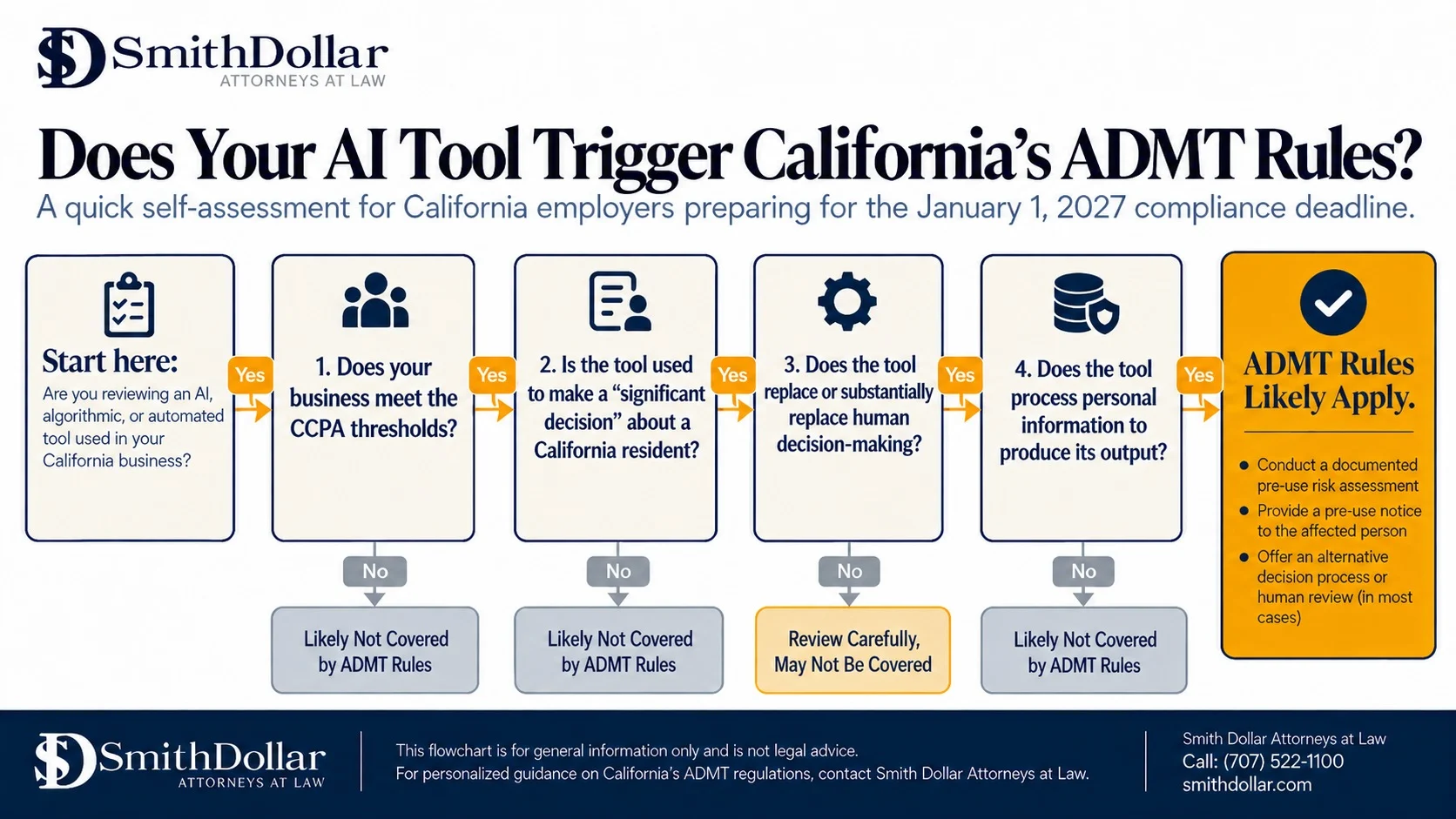
Effective January 1, 2027, these rules apply to employers that use AI, algorithmic scoring, or other automated tools to make “significant decisions” about California residents. Covered decisions include:
- Hiring and promotion
- Discipline and termination
- Compensation decisions
Before using the technology, covered employers must:
- Conduct a documented risk assessment
- Provide a pre-use notice to the affected person
- Offer an alternative decision process or human review (in most cases)
Risk assessments are due to the California Privacy Protection Agency by April 1 of the following year.
SB 53: Transparency in Frontier Artificial Intelligence Act
The core law took effect in 2026. Its 2027 provisions mostly affect state agencies and the largest AI developers, with annual anonymized reports from the Office of Emergency Services, whistleblower summaries from the Attorney General, and recommended definition updates from the Department of Technology.
Most Santa Rosa employers are not frontier developers. If your business licenses AI tools from large vendors, expect vendor contracts and system cards to tighten in response.
Corporate and Business Compliance Changes
Beyond employment and privacy, a few other 2027 effective dates deserve a note on your calendar:
- SB 646 requires manufacturers and brand owners of prenatal multivitamins sold in California to test each lot for arsenic, cadmium, lead, and mercury beginning January 1.
- AB 60 bans the manufacture, sale, and distribution of cosmetic products containing certain intentionally added musk ingredients and caps musk ketone concentrations by product category.
- Climate disclosure obligations under SB 253 and SB 261 continue to work through litigation at the Ninth Circuit, and the final shape of required greenhouse gas and climate-risk reporting for large companies may shift during 2027.
If your business operates in a regulated vertical such as food and beverage, cosmetics, alcohol, cannabis, or financial services, year-end is the right time to confirm with a business attorney in Santa Rosa whether any sector-specific January 1 rule applies.
Industry-Specific Changes North Bay Businesses Should Watch
Smith Dollar’s clients work across several industries, and a few 2027 changes stand out by sector.
Construction and Contractors
The major California construction changes landed on January 1, 2026:
- SB 61 five-percent retention cap on private projects
- SB 440‘s standardized change-order process
One year in, this is a good moment to review how your contract templates, invoicing cycles, and payment disputes have actually been handled under the new rules, and whether your subcontract flow-downs match.
Wineries, Hospitality, and Agriculture
Hotels with 50 or more rooms, event centers, and private clubs need to confirm their policies around the January 1 sunset of AB 858’s rehire obligations.
Tipped-wage practices, mandatory service charges, and seasonal hiring also warrant a check given SB 648’s 2026 gratuities changes.
Retail and Professional Services
The browser opt-out requirement under AB 566 catches almost any business that runs a California-facing website with advertising or analytics. Retailers that sell cosmetics also need to confirm compliance with AB 60 before January.
Preparing Your Business for January 1
- Run a payroll and classification check. Confirm every exempt employee will earn at least $72,384 after January 1, and verify non-exempt hourly rates meet the applicable state, local, and industry floor.
- Map your pay data to the 23 SOC categories. HR systems often need manual mapping, and the May 2027 report is built from 2026 data.
- Audit your website’s data flow and consent setup. Opt-out preference signals need to work end-to-end, including with third-party vendors.
- Inventory any AI or automated tool used in hiring, promotion, discipline, pay, or termination. The CCPA ADMT rules require documentation before use.
- Update handbooks, policies, and vendor contracts. Many compliance gaps live in paperwork that was last touched years ago.
Get a Compliance Review Before January 1 with Smith Dollar
Compliance work moves faster when someone has already read the law, mapped the deadlines, and knows which pieces apply to your industry. Since 2005, Smith Dollar has handled year-end compliance reviews, handbook updates, employment agreements, privacy questions, and dispute strategy for businesses across Sonoma County and the North Bay.
Whether you need a focused review before January 1 or ongoing counsel through 2027, a business attorney in Santa Rosa at Smith Dollar can help you set priorities and keep your operations moving.
Call (707) 522-1100 or reach out online to schedule a consultation.
Frequently Asked Questions
The $17.40 per hour statewide minimum wage applies to all employers in California starting January 1, 2027. The same change raises the salary floor for executive, administrative, and professional exemptions to $72,384 per year ($1,392 per week).
If your business sells or shares California residents’ personal information under the CCPA and runs a website, yes. AB 566 places the browser-side obligation on major developers, but websites still have to detect and honor the opt-out preference signal across all vendors and data processors in their stack.
The CCPA Automated Decision-Making Technology regulations generally apply to businesses that already fall under the CCPA, meaning for-profit entities meeting the CCPA’s revenue or data thresholds.
Small employers may be exempt from the CCPA itself, but any employer using AI in hiring should still watch for Fair Employment and Housing Act anti-discrimination updates and pending bills like SB 947.
This article provides general information and is not intended as legal advice. Reading this does not create an attorney-client relationship. For personalized legal guidance, please consult an attorney.
The calendar between Halloween and New Year’s Day tends to move fast for California business owners. Payroll runs close out, handbooks go to print, and the January 1 compliance clock starts ticking before most people have cleared the holiday decorations.
2027 brings a familiar batch of changes: a new minimum wage, higher exempt salary thresholds, expanded pay data reporting, new privacy signal requirements, and the first real enforcement window for California’s rules on automated decision-making.
A business attorney in Santa Rosa can help you sort what applies to your company, what can wait, and what needs to happen before the first paycheck of the new year.
Key Takeaways
- California’s minimum wage rises to $17.40 per hour on January 1, 2027, which also pushes the exempt salary threshold to $72,384 per year.
- New rules on automated decision-making in employment and expanded pay data reporting both carry 2027 effective dates and require internal review well before January.
- Industry-specific changes affect wineries, hospitality operators, construction firms, and retailers across the North Bay, so a year-end compliance check is time well spent.
California Minimum Wage and Exempt Salary Changes for 2027
On July 31, 2026, the California Department of Finance certified the 2027 statewide minimum wage at $17.40 per hour, up from $16.90. The increase takes effect January 1, 2027 and applies to every employer, regardless of size.
The same change raises the salary floor for the executive, administrative, and professional overtime exemptions.
In 2027, an exempt employee must earn at least $72,384 per year ($1,392 per week, $6,032 per month) in fixed salary to qualify. Anyone paid below that figure after January 1 cannot be classified as exempt under the white-collar rules, no matter their job duties.
A few points worth checking before year-end:
- Santa Rosa has its own local minimum wage, which adjusts every January 1, as do many other Bay Area cities. If employees work in multiple jurisdictions, the higher rate controls.
- Fast food restaurants under Labor Code § 1474 still have a $20 minimum wage, with an exempt salary threshold of $83,200.
- Computer software employees and licensed physicians have separate hourly and salary rates that adjust each year.
Employment Law Changes Businesses Need to Prepare For
Three employment-side changes take effect January 1, 2027. Each one needs attention before year-end.
SB 464: Expanded Pay Data Reporting
Employers with 100 or more workers must now classify employees in 23 Standard Occupational Classification (SOC) categories instead of the 10 federal EEO-1 categories.
The expanded report, built from 2026 data, is due to the Civil Rights Department in May 2027. Job mapping needs to happen now.
AB 1523: Higher Mediation Threshold
Mandatory court-ordered mediation for civil cases rises from $50,000 to $75,000. For smaller business disputes, that often means a faster, less expensive resolution than full litigation.
AB 858: Hospitality Rehire Rights Sunset
COVID-era recall obligations for hotels with 50 or more rooms, event centers, private clubs, airport service providers, and building service contractors end on January 1, 2027.
Policies and employee handbooks that reference those rights should be reviewed with employment counsel before the sunset.
Privacy, Technology, and Data Requirements
AB 566, the California Opt Me Out Act, becomes operative on January 1, 2027. It amends the CCPA to require browsers serving California users to include a built-in universal opt-out preference signal. Browsers must offer the signal. Websites must detect and honor it.
If your business sells or shares personal information under the CCPA (including data broker arrangements, cross-site advertising pixels, and some analytics setups), your technical stack has to recognize signals such as Global Privacy Control and treat them as valid opt-out requests across every vendor in the data chain.
A few practical steps worth taking before January:
- Audit which tags, pixels, and vendors on your site process California visitor data.
- Confirm that your consent management platform processes opt-out preference signals correctly.
- Update vendor contracts so third parties are required to honor signals received through your site.
Enforcement sits with the California Privacy Protection Agency and the Attorney General, both of whom have been active since the CCPA took effect.
AI Rules That May Affect Business Operations
Two different rulebooks apply here, and they often get mixed up.
CCPA Automated Decision-Making Technology (ADMT) Regulations
Effective January 1, 2027, these rules apply to employers that use AI, algorithmic scoring, or other automated tools to make “significant decisions” about California residents. Covered decisions include:
- Hiring and promotion
- Discipline and termination
- Compensation decisions
Before using the technology, covered employers must:
- Conduct a documented risk assessment
- Provide a pre-use notice to the affected person
- Offer an alternative decision process or human review (in most cases)
Risk assessments are due to the California Privacy Protection Agency by April 1 of the following year.
SB 53: Transparency in Frontier Artificial Intelligence Act
The core law took effect in 2026. Its 2027 provisions mostly affect state agencies and the largest AI developers, with annual anonymized reports from the Office of Emergency Services, whistleblower summaries from the Attorney General, and recommended definition updates from the Department of Technology.
Most Santa Rosa employers are not frontier developers. If your business licenses AI tools from large vendors, expect vendor contracts and system cards to tighten in response.
Corporate and Business Compliance Changes
Beyond employment and privacy, a few other 2027 effective dates deserve a note on your calendar:
- SB 646 requires manufacturers and brand owners of prenatal multivitamins sold in California to test each lot for arsenic, cadmium, lead, and mercury beginning January 1.
- AB 60 bans the manufacture, sale, and distribution of cosmetic products containing certain intentionally added musk ingredients and caps musk ketone concentrations by product category.
- Climate disclosure obligations under SB 253 and SB 261 continue to work through litigation at the Ninth Circuit, and the final shape of required greenhouse gas and climate-risk reporting for large companies may shift during 2027.
If your business operates in a regulated vertical such as food and beverage, cosmetics, alcohol, cannabis, or financial services, year-end is the right time to confirm with a business attorney in Santa Rosa whether any sector-specific January 1 rule applies.
Industry-Specific Changes North Bay Businesses Should Watch
Smith Dollar’s clients work across several industries, and a few 2027 changes stand out by sector.
Construction and Contractors
The major California construction changes landed on January 1, 2026:
- SB 61 five-percent retention cap on private projects
- SB 440‘s standardized change-order process
One year in, this is a good moment to review how your contract templates, invoicing cycles, and payment disputes have actually been handled under the new rules, and whether your subcontract flow-downs match.
Wineries, Hospitality, and Agriculture
Hotels with 50 or more rooms, event centers, and private clubs need to confirm their policies around the January 1 sunset of AB 858’s rehire obligations.
Tipped-wage practices, mandatory service charges, and seasonal hiring also warrant a check given SB 648’s 2026 gratuities changes.
Retail and Professional Services
The browser opt-out requirement under AB 566 catches almost any business that runs a California-facing website with advertising or analytics. Retailers that sell cosmetics also need to confirm compliance with AB 60 before January.
Preparing Your Business for January 1
- Run a payroll and classification check. Confirm every exempt employee will earn at least $72,384 after January 1, and verify non-exempt hourly rates meet the applicable state, local, and industry floor.
- Map your pay data to the 23 SOC categories. HR systems often need manual mapping, and the May 2027 report is built from 2026 data.
- Audit your website’s data flow and consent setup. Opt-out preference signals need to work end-to-end, including with third-party vendors.
- Inventory any AI or automated tool used in hiring, promotion, discipline, pay, or termination. The CCPA ADMT rules require documentation before use.
- Update handbooks, policies, and vendor contracts. Many compliance gaps live in paperwork that was last touched years ago.
Get a Compliance Review Before January 1 with Smith Dollar
Compliance work moves faster when someone has already read the law, mapped the deadlines, and knows which pieces apply to your industry. Since 2005, Smith Dollar has handled year-end compliance reviews, handbook updates, employment agreements, privacy questions, and dispute strategy for businesses across Sonoma County and the North Bay.
Whether you need a focused review before January 1 or ongoing counsel through 2027, a business attorney in Santa Rosa at Smith Dollar can help you set priorities and keep your operations moving.
Call (707) 522-1100 or reach out online to schedule a consultation.
Frequently Asked Questions
The $17.40 per hour statewide minimum wage applies to all employers in California starting January 1, 2027. The same change raises the salary floor for executive, administrative, and professional exemptions to $72,384 per year ($1,392 per week).
If your business sells or shares California residents’ personal information under the CCPA and runs a website, yes. AB 566 places the browser-side obligation on major developers, but websites still have to detect and honor the opt-out preference signal across all vendors and data processors in their stack.
The CCPA Automated Decision-Making Technology regulations generally apply to businesses that already fall under the CCPA, meaning for-profit entities meeting the CCPA’s revenue or data thresholds.
Small employers may be exempt from the CCPA itself, but any employer using AI in hiring should still watch for Fair Employment and Housing Act anti-discrimination updates and pending bills like SB 947.
This article provides general information and is not intended as legal advice. Reading this does not create an attorney-client relationship. For personalized legal guidance, please consult an attorney.

Related Posts


 How Should a California Business Respond to a Breach of Contract? A Step-by-Step Checklist