A missed deadline. An unpaid invoice. A vendor who stops answering emails. California business owners deal with contract problems more often than they would like, and the first decisions made after a breach shape everything that follows.
Rushing to terminate, firing off an angry email, or ignoring the issue entirely can all cost real money.
This checklist walks through the practical steps a California business should take when the other side does not perform. It covers how to read the contract, how to document the breach, how to limit losses, and when it makes sense to call a business law attorney in Santa Rosa before the situation gets worse.
Key Takeaways
- Read the full contract before sending a demand letter or terminating the agreement.
- Preserve written communications, invoices, and performance records early, before anything else.
- California gives you 4 years to sue on a written contract and 2 years on an oral one.
- Most contracts require written notice and a cure period before termination.
- The duty to mitigate damages applies even when the other side is clearly at fault.
- Early legal input usually costs less than fixing a mishandled breach after a lawsuit is filed.
1. Read Through the Contract Before Responding
Before sending a single email, pull the signed contract and read it end to end. The written agreement controls almost every decision that follows.
Look specifically for:
- Scope and deliverables. What exactly did each party promise?
- Deadlines and performance dates. Is the missed date in the contract or in a side email?
- Notice provisions. Where must notice be sent, in what format, and to whom?
- Cure period. How many days does the other side have to fix the problem?
- Dispute resolution clause. Does the contract require mediation or arbitration before a lawsuit?
- Choice of law and venue. Which state’s law applies, and where must disputes be filed?
If the contract has been amended or extended by email, print those exchanges and keep them with the original. California courts look at the full written record, not just the signed version.
2. Identify Exactly What Was Breached
A vague complaint carries little weight. Pin down the specific obligation that was broken, the date it was broken, and the facts that prove it.
Work through these questions:
- Which clause was violated? Point to the paragraph, not the general spirit of the agreement.
- What was promised versus delivered? Note the gap in specific terms.
- Is this a material or minor breach? A material breach goes to the heart of the deal and can justify termination. A minor breach usually supports only a claim for damages.
- Is the breach ongoing or complete? This affects both the damages number and the timing of any response.
3. Preserve the Evidence
Evidence disappears quickly after a dispute heats up. Lock down the record early.
Items to collect:
- The signed contract and every amendment, change order, or addendum.
- Emails and text messages between the parties about performance, deadlines, and complaints.
- Invoices, payment records, and bank statements showing what was paid and when.
- Delivery receipts, timesheets, inspection reports, or other proof of performance.
- Internal notes and meeting minutes that document the dispute as it developed.
- Voicemails or recorded calls permitted under California’s recording laws.
Store copies in a dedicated folder with a backup. Tell staff to stop deleting emails related to the account. If calendars, project management tools, or messaging apps hold relevant data, export it before the account cycles out.
4. Calculate the Business Impact
Damages drive almost every decision in a contract dispute. Figure out what the breach is actually costing the business before deciding on a response.
Common categories to measure:
- Direct losses. Payments owed, cost to complete the work, replacement cost of goods.
- Consequential damages. Lost profits, downstream penalties, delays on other projects.
- Mitigation costs. Money spent to limit the harm, which is often recoverable.
- Soft costs. Staff time, lost customer trust, operational disruption.
If the number is small compared to likely legal fees, a short conversation and a payment plan may make more sense than a lawsuit. If the number is large, early documentation of each category pays off later.
5. Check Notice and Cure Requirements Before Terminating
This is where many breaches get mishandled. California contracts frequently require written notice and a stated cure period before a party can walk away. Terminating without following these steps can turn the non-breaching party into the one in breach.
Before ending the agreement:
- Confirm what the notice clause requires. Mail, email, certified delivery, signed receipt?
- Send notice to the exact address listed in the contract, not the one you have been using day to day.
- Describe the breach specifically. General complaints often fail as proper notice.
- State the cure period and the date by which performance is required.
- Preserve all rights. Include language stating that no waiver is intended by any continued performance during the cure window.
Even if the other side is clearly in breach, skipping the notice process can give them a defense and reduce the damages your business can recover.
6. Take Reasonable Steps to Limit Additional Losses
California follows the duty to mitigate. A business that lets damages pile up when reasonable steps could have reduced them may not recover the full amount at trial.
Practical mitigation steps:
- Line up a replacement vendor, contractor, or supplier so operations continue.
- Keep performing your own obligations where the contract allows, unless performance is excused.
- Document each mitigation decision and the reasoning behind it.
- Avoid rash spending that would not pass a reasonableness test later.
Keep receipts and emails tied to every mitigation step. The record itself helps prove the amount of the loss.
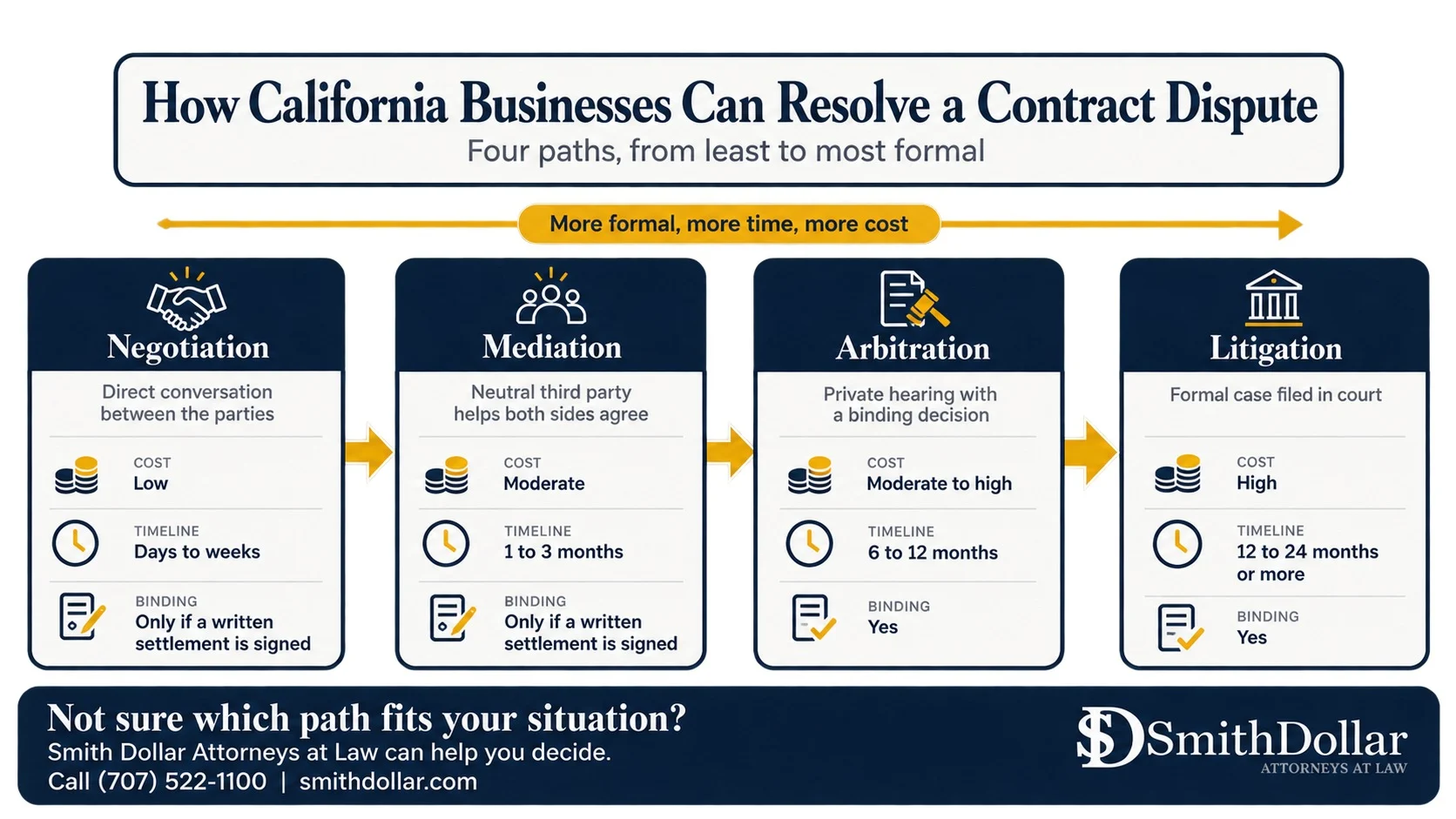
7. Consider Negotiation, Mediation, or Arbitration Before Filing Suit
Litigation is slow and expensive. California business cases often take 12 to 24 months to reach trial, and attorney fees add up long before that. Many contract disputes resolve faster and cheaper through other paths.
Options to weigh:
- Direct negotiation. A clear demand letter with supporting documents often prompts a settlement conversation.
- Mediation. A neutral mediator helps both sides reach a voluntary agreement. Many contracts require it as a first step.
- Arbitration. A private process that ends in a binding decision. Required if the contract contains an arbitration clause.
- Litigation. The right tool when the other side will not engage, when fast enforcement is needed, or when the contract calls for it.
The resolution clause in the contract often controls the first move. Read it before sending any demand letter.
8. Understand How Long You Have to Act
Every contract claim has a deadline. In California, the general rules are:
- Written contracts: 4 years from the date of the breach (Code of Civil Procedure § 337).
- Oral contracts: 2 years from the date of the breach (Code of Civil Procedure § 339).
Shorter deadlines can apply to certain claims, including some arising out of construction, employment, or insurance disputes. The clock usually starts on the date performance was due, not the date the problem was discovered.
Missing the deadline closes the courthouse door regardless of how strong the case is. If the breach is recent, there is time to plan. If the breach happened a year or more ago, confirm the deadline with a business law attorney in Santa Rosa before taking any next step.
9. Know the Signs It Is Time to Call an Attorney
Not every breach needs a lawyer. Many small disputes resolve with a phone call and a corrected invoice. Legal counsel adds the most value when the stakes, complexity, or legal risk justify it.
Signs legal input makes sense now:
- The amount in dispute is significant to the business.
- The contract contains arbitration, indemnity, or liquidated damages clauses.
- The other side has already involved their own counsel.
- Termination, injunctive relief, or specific performance may be needed.
- The dispute involves multiple parties, a public project, or a regulated industry.
- Documentation is thin and the business needs help preserving its position.
Call sooner rather than later when:
- A deadline, notice period, or statute of limitations is approaching.
- The other side has sent a demand letter, lawsuit, or formal notice.
- The contract requires arbitration or mediation within a short window.
- Business operations will stop or lose major revenue without a resolution.
- The dispute touches intellectual property, licensing, or confidential information.
An early consultation often costs less than correcting a mishandled breach after a lawsuit is filed. A business law attorney in Santa Rosa can review the contract, assess the strength of the claim, and recommend a path that fits the goals of the business.
When a Contract Dispute Threatens Your Business, Smith Dollar Can Help
Smith Dollar Attorneys at Law has worked with businesses across Sonoma County and Northern California for over two decades on contract disputes, business litigation, and the day-to-day legal work that keeps companies running. Our firm’s approach is practical, communication-first, and focused on helping clients keep their businesses moving forward.
If a contract problem is developing, early input can protect the business’s rights and often resolves the matter without a lawsuit. Contact us online or call Smith Dollar Attorneys at (707) 522-1100 to schedule your consultation today.
Frequently Asked Questions
A breach of contract happens when one party fails to perform a duty required by a valid agreement, without a legal excuse. The failure can be:
- A missed deadline
- Incomplete work
- Non-payment
- Delivery of something other than what was promised
California distinguishes between material breaches, which go to the heart of the deal, and minor breaches, which usually support only a damages claim.
Under California Code of Civil Procedure § 337, a business has 4 years to sue on a written contract. For oral contracts, § 339 gives 2 years. The clock usually starts on the date the breach occurred, not the date it was discovered.
Shorter deadlines can apply to specific types of claims, so confirming the exact deadline with an attorney is often worth the time.
Sometimes, but it depends on the contract. Most agreements require written notice and a cure period before termination is allowed. The breach also usually needs to be material, meaning it defeats the purpose of the contract.
Terminating without following these steps can expose the business to its own breach claim.
This article provides general information and is not intended as legal advice. Reading this does not create an attorney-client relationship. For personalized legal guidance, please consult an attorney.
A missed deadline. An unpaid invoice. A vendor who stops answering emails. California business owners deal with contract problems more often than they would like, and the first decisions made after a breach shape everything that follows.
Rushing to terminate, firing off an angry email, or ignoring the issue entirely can all cost real money.
This checklist walks through the practical steps a California business should take when the other side does not perform. It covers how to read the contract, how to document the breach, how to limit losses, and when it makes sense to call a business law attorney in Santa Rosa before the situation gets worse.
Key Takeaways
- Read the full contract before sending a demand letter or terminating the agreement.
- Preserve written communications, invoices, and performance records early, before anything else.
- California gives you 4 years to sue on a written contract and 2 years on an oral one.
- Most contracts require written notice and a cure period before termination.
- The duty to mitigate damages applies even when the other side is clearly at fault.
- Early legal input usually costs less than fixing a mishandled breach after a lawsuit is filed.
1. Read Through the Contract Before Responding
Before sending a single email, pull the signed contract and read it end to end. The written agreement controls almost every decision that follows.
Look specifically for:
- Scope and deliverables. What exactly did each party promise?
- Deadlines and performance dates. Is the missed date in the contract or in a side email?
- Notice provisions. Where must notice be sent, in what format, and to whom?
- Cure period. How many days does the other side have to fix the problem?
- Dispute resolution clause. Does the contract require mediation or arbitration before a lawsuit?
- Choice of law and venue. Which state’s law applies, and where must disputes be filed?
If the contract has been amended or extended by email, print those exchanges and keep them with the original. California courts look at the full written record, not just the signed version.
2. Identify Exactly What Was Breached
A vague complaint carries little weight. Pin down the specific obligation that was broken, the date it was broken, and the facts that prove it.
Work through these questions:
- Which clause was violated? Point to the paragraph, not the general spirit of the agreement.
- What was promised versus delivered? Note the gap in specific terms.
- Is this a material or minor breach? A material breach goes to the heart of the deal and can justify termination. A minor breach usually supports only a claim for damages.
- Is the breach ongoing or complete? This affects both the damages number and the timing of any response.
3. Preserve the Evidence
Evidence disappears quickly after a dispute heats up. Lock down the record early.
Items to collect:
- The signed contract and every amendment, change order, or addendum.
- Emails and text messages between the parties about performance, deadlines, and complaints.
- Invoices, payment records, and bank statements showing what was paid and when.
- Delivery receipts, timesheets, inspection reports, or other proof of performance.
- Internal notes and meeting minutes that document the dispute as it developed.
- Voicemails or recorded calls permitted under California’s recording laws.
Store copies in a dedicated folder with a backup. Tell staff to stop deleting emails related to the account. If calendars, project management tools, or messaging apps hold relevant data, export it before the account cycles out.
4. Calculate the Business Impact
Damages drive almost every decision in a contract dispute. Figure out what the breach is actually costing the business before deciding on a response.
Common categories to measure:
- Direct losses. Payments owed, cost to complete the work, replacement cost of goods.
- Consequential damages. Lost profits, downstream penalties, delays on other projects.
- Mitigation costs. Money spent to limit the harm, which is often recoverable.
- Soft costs. Staff time, lost customer trust, operational disruption.
If the number is small compared to likely legal fees, a short conversation and a payment plan may make more sense than a lawsuit. If the number is large, early documentation of each category pays off later.
5. Check Notice and Cure Requirements Before Terminating
This is where many breaches get mishandled. California contracts frequently require written notice and a stated cure period before a party can walk away. Terminating without following these steps can turn the non-breaching party into the one in breach.
Before ending the agreement:
- Confirm what the notice clause requires. Mail, email, certified delivery, signed receipt?
- Send notice to the exact address listed in the contract, not the one you have been using day to day.
- Describe the breach specifically. General complaints often fail as proper notice.
- State the cure period and the date by which performance is required.
- Preserve all rights. Include language stating that no waiver is intended by any continued performance during the cure window.
Even if the other side is clearly in breach, skipping the notice process can give them a defense and reduce the damages your business can recover.
6. Take Reasonable Steps to Limit Additional Losses
California follows the duty to mitigate. A business that lets damages pile up when reasonable steps could have reduced them may not recover the full amount at trial.
Practical mitigation steps:
- Line up a replacement vendor, contractor, or supplier so operations continue.
- Keep performing your own obligations where the contract allows, unless performance is excused.
- Document each mitigation decision and the reasoning behind it.
- Avoid rash spending that would not pass a reasonableness test later.
Keep receipts and emails tied to every mitigation step. The record itself helps prove the amount of the loss.
7. Consider Negotiation, Mediation, or Arbitration Before Filing Suit
Litigation is slow and expensive. California business cases often take 12 to 24 months to reach trial, and attorney fees add up long before that. Many contract disputes resolve faster and cheaper through other paths.
Options to weigh:
- Direct negotiation. A clear demand letter with supporting documents often prompts a settlement conversation.
- Mediation. A neutral mediator helps both sides reach a voluntary agreement. Many contracts require it as a first step.
- Arbitration. A private process that ends in a binding decision. Required if the contract contains an arbitration clause.
- Litigation. The right tool when the other side will not engage, when fast enforcement is needed, or when the contract calls for it.
The resolution clause in the contract often controls the first move. Read it before sending any demand letter.
8. Understand How Long You Have to Act
Every contract claim has a deadline. In California, the general rules are:
- Written contracts: 4 years from the date of the breach (Code of Civil Procedure § 337).
- Oral contracts: 2 years from the date of the breach (Code of Civil Procedure § 339).
Shorter deadlines can apply to certain claims, including some arising out of construction, employment, or insurance disputes. The clock usually starts on the date performance was due, not the date the problem was discovered.
Missing the deadline closes the courthouse door regardless of how strong the case is. If the breach is recent, there is time to plan. If the breach happened a year or more ago, confirm the deadline with a business law attorney in Santa Rosa before taking any next step.
9. Know the Signs It Is Time to Call an Attorney
Not every breach needs a lawyer. Many small disputes resolve with a phone call and a corrected invoice. Legal counsel adds the most value when the stakes, complexity, or legal risk justify it.
Signs legal input makes sense now:
- The amount in dispute is significant to the business.
- The contract contains arbitration, indemnity, or liquidated damages clauses.
- The other side has already involved their own counsel.
- Termination, injunctive relief, or specific performance may be needed.
- The dispute involves multiple parties, a public project, or a regulated industry.
- Documentation is thin and the business needs help preserving its position.
Call sooner rather than later when:
- A deadline, notice period, or statute of limitations is approaching.
- The other side has sent a demand letter, lawsuit, or formal notice.
- The contract requires arbitration or mediation within a short window.
- Business operations will stop or lose major revenue without a resolution.
- The dispute touches intellectual property, licensing, or confidential information.
An early consultation often costs less than correcting a mishandled breach after a lawsuit is filed. A business law attorney in Santa Rosa can review the contract, assess the strength of the claim, and recommend a path that fits the goals of the business.
When a Contract Dispute Threatens Your Business, Smith Dollar Can Help
Smith Dollar Attorneys at Law has worked with businesses across Sonoma County and Northern California for over two decades on contract disputes, business litigation, and the day-to-day legal work that keeps companies running. Our firm’s approach is practical, communication-first, and focused on helping clients keep their businesses moving forward.
If a contract problem is developing, early input can protect the business’s rights and often resolves the matter without a lawsuit. Contact us online or call Smith Dollar Attorneys at (707) 522-1100 to schedule your consultation today.
Frequently Asked Questions
A breach of contract happens when one party fails to perform a duty required by a valid agreement, without a legal excuse. The failure can be:
- A missed deadline
- Incomplete work
- Non-payment
- Delivery of something other than what was promised
California distinguishes between material breaches, which go to the heart of the deal, and minor breaches, which usually support only a damages claim.
Under California Code of Civil Procedure § 337, a business has 4 years to sue on a written contract. For oral contracts, § 339 gives 2 years. The clock usually starts on the date the breach occurred, not the date it was discovered.
Shorter deadlines can apply to specific types of claims, so confirming the exact deadline with an attorney is often worth the time.
Sometimes, but it depends on the contract. Most agreements require written notice and a cure period before termination is allowed. The breach also usually needs to be material, meaning it defeats the purpose of the contract.
Terminating without following these steps can expose the business to its own breach claim.
This article provides general information and is not intended as legal advice. Reading this does not create an attorney-client relationship. For personalized legal guidance, please consult an attorney.